Author: Leo Antony Raj, Senior Trainer, Systech Group Reviewed: August 2026
TL;DR
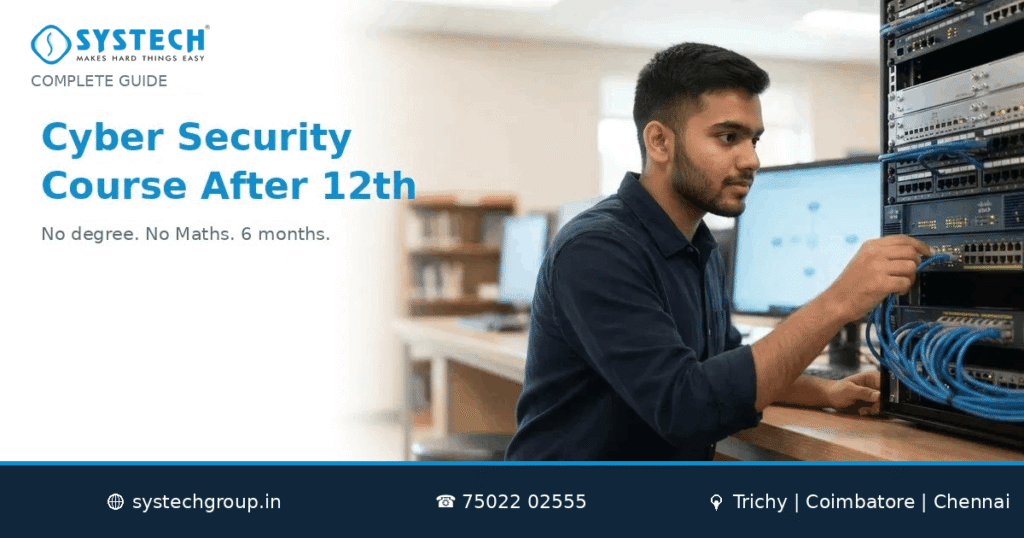
You can start a cyber security career after 12th without a degree and without Maths. Two routes exist. A degree takes 3 to 4 years and costs between ₹2 lakh and ₹14 lakh. A certification route takes 6 months and costs ₹50,000 for classroom training, plus 18% GST. The certification route starts with hardware and networking, not with hacking. This guide covers the cost of each, who is eligible, and how to choose.
Table of Contents
Can you study cyber security after 12th?
Yes. You can start a cyber security course straight after 12th, in any stream, with or without Maths. There are two paths. One is a degree such as B.Tech, BCA or B.Sc with a cyber security specialisation. The other is a certification route that runs 6 months and does not require a degree at all.
Most guides on this topic only cover the first path. That is because most of them are published by universities and colleges that sell degrees.
Both paths are real. They suit different students. If you finished 12th with strong Maths marks and your family can fund four years of college, the degree route is open to you. If you did Commerce or Arts, or your marks were not what you hoped, or four years of fees is not realistic, the certification route exists and it works.
For a wider view of short-term options, see our Cyber Security Course in Chennai
The 4 routes after 12th, and what each one really costs
A B.Tech in cyber security costs between ₹1.5 lakh and ₹3.5 lakh per year across 4 years. A certification route costs ₹50,000 for classroom training and takes 6 months. The degree gives you a degree. The certification gives you the specific skills employers test for in an interview.
Here are the four routes, ranked by cost.
1. B.Tech CSE with Cyber Security
- Duration: 4 years
- Total cost: ₹6 lakh to ₹14 lakh
- Eligibility: 12th with Physics, Chemistry and Maths, usually 50% minimum. Many colleges also require an entrance exam.
- You finish with: A degree, campus placement access, and a broad computer science base.
This is the route every college blog recommends. It is a genuine option if you have the marks, the money, and the four years.
2. B.Sc or BCA in Cyber Security
- Duration: 3 years
- Total cost: ₹2 lakh to ₹6 lakh
- Eligibility: 12th in any stream at most colleges. Some require Maths.
- You finish with: A degree and a working knowledge of security fundamentals.
Cheaper and shorter than B.Tech. Many students then add certifications on top, because a degree alone rarely covers hands-on network configuration.
3. Diploma in Cyber Security
- Duration: 1 year
- Total cost: Varies widely by institute
- Eligibility: 10th or 12th pass
- You finish with: A certificate and some tool familiarity.
Quality varies enormously here. Check what hardware you will actually touch before you pay.
4. Certification route
- Duration: 6 months
- Total cost: ₹50,000 for classroom training, plus 18% GST
- Eligibility: 12th pass, any stream. No entrance exam.
- You finish with: 15 course certificates, CCNA exam eligibility, and hands-on time on real enterprise hardware.
At Systech this is the Cyber Security and Networking Bundle. It runs 6 months in classroom mode at Trichy, Coimbatore and Chennai.
Three of those 15 courses have published individual prices. Hardware and Networking is ₹5,000. Windows Server 2025 is ₹25,000. CCNA is ₹15,000. That is ₹45,000 for three of the fifteen. The full bundle is ₹50,000, so the remaining twelve courses come to ₹5,000 between them.
Paying in one instalment brings ₹2,500 off. If that is not workable, you start with 50% and pay the rest in two parts.
The full list of individual course fees is on our course fees page.
A note on online pricing. Our online cyber security programme is priced at ₹99,999 plus GST. It is not the same product delivered remotely. It is one-to-one personal tutoring with a trainer. The ₹50,000 figure above is for classroom training only.
Do you need Maths or a science stream?
For a B.Tech, yes. Most engineering colleges require Physics, Chemistry and Maths in 12th with a 50% minimum, and many run an entrance exam. For the certification route, no. Commerce and Arts students are eligible. There is no cut-off mark and no entrance test.
This is the question we get asked most often at the Trichy centre, and it is the one almost no guide answers directly.
What actually matters in networking and security work is logical thinking. Can you follow a sequence of steps and work out where it broke? That skill is not measured by your 12th marks.
Two more practical points:
- Weak English is not a barrier. We teach in Tamil and English. Most of our students at Trichy learn in Tamil.
- No degree is not a barrier. Networking is one of the few IT fields where a recruiter asks what you can configure rather than what you scored.
Why cyber security is the wrong place to start
Cyber security is not a beginner subject. Before you can secure a network, you have to understand how one works. That means hardware, routers, switches and servers first. Any course promising to turn you into a hacker in 3 months is skipping the part that gets you hired.
This is the single most common mistake we see. A student walks in after 12th and asks to learn hacking. Six weeks later he is stuck, because the tools he wanted to use assume he already knows what a subnet is.
Think about it from the employer’s side. Nobody hires a security engineer who cannot read a network diagram. The security layer sits on top of the networking layer. You cannot skip the floor and start on the first storey.
If you are starting from zero, read our guide on hardware and networking courses after 12th first. That is the actual starting point.
What you learn on the certification route, in order
The sequence runs hardware and networking, then CCNA, then Windows Server, then the security layer of firewalls, SOC and penetration testing. Six months, taken in that order. Each stage assumes the one before it.
- Hardware and Networking. How computers, cables, switches and routers physically connect. The foundation for everything after.
- CCNA. Cisco’s networking certification, exam code 200-301. This is the credential recruiters filter on.
- Windows Server 2025. How company servers, users and permissions are managed.
- MPLS, SD-WAN, NLD, NAS, Fiber Optic, OLT, VOIP. The technologies that connect offices across cities.
- Cyber Security and Ethical Hacking. How attacks work, and how they are stopped.
- Penetration Testing and SOC. Testing systems for weaknesses, and monitoring live attacks using SIEM tools.
- Python for Networking. Scripting to automate network tasks. This is not software engineering.
What you actually touch
Reading about a router is not the same as configuring one. Three things at our centres are worth knowing about before you compare institutes:
- Your own lab bench. Real Cisco routers, switches and firewalls, one set per student. You are not sitting at the back watching someone else practise.
- A live network between three cities. Our Trichy, Coimbatore and Chennai branches are connected by a real MPLS, NLD and SD-WAN link. Students configure and troubleshoot it. On your first day at a job, you are not seeing an enterprise network for the first time.
- Physical hacking hardware. Rubber Ducky, Pwnagotchi, RFID cloners, RTL-SDR, Alfa antennas, lock picks. You hold the actual tools, rather than watching a video about them.
You also write your official Cisco exam in the same building you studied in. Our Trichy centre is a Pearson VUE and PSI authorised test centre, so there is no travelling to another city on exam day
What jobs can you get, and what do they pay?
Entry-level roles after this route are network engineer, network security engineer, SOC analyst L1, and desktop or systems support moving into networking. Pay depends on your city, the employer and what you can actually demonstrate. Treat any single salary figure you read online with caution, including on the pages ranking above this one.
Five roles this training points towards:
- Network Engineer. Configures and maintains company networks.
- Network Security Engineer. Configures firewalls and access rules.
- SOC Analyst. Monitors live systems for attacks using SIEM tools.
- Penetration Tester. Tests systems for weaknesses before attackers find them.
- Systems or Server Administrator. Manages servers, users and backups.
On placement, we will be direct with you. We do not promise you a job. Companies and recruiters contact us when they need networking and security engineers, and we refer our strongest students. What we can do is make sure you are the one worth referring.
If government work interests you, we have a separate guide on cyber security government jobs.
How can you study cybercrime and digital forensics?
Cyber crime work sits mostly in police cyber cells, government agencies and corporate fraud teams. The technical base is the same as any security role, which is networking first, then security. Forensics adds evidence handling and legal procedure on top, and those elements are usually learned through a government or law enforcement programme rather than a private course.
If cyber crime investigation is your goal, the practical order is:
- Build the networking and security base. This is what the 6 month route gives you.
- Add a forensics or cyber law qualification afterwards, or apply to a state cyber cell recruitment.
- Some students take a B.Com in Cyber Law or a forensics diploma alongside, if a degree is part of the plan.
The base does not change. You still need to understand a network before you can investigate what happened on one.
Can you do a cyber security course after 12th online?
Yes, online options exist, but they are not all the same thing. Recorded video courses are cheap and suit revision. Live one-to-one tutoring costs considerably more and behaves like private tuition. Classroom training is the only format where you physically configure real hardware.
For this subject, the hardware matters. You can watch a hundred hours of video about configuring a Cisco switch and still freeze when someone hands you one.
Our own online programme is one-to-one tutoring at ₹99,999 plus GST. It exists for students who genuinely cannot attend a centre. If you can reach Trichy, Coimbatore or Chennai, classroom at ₹50,000 plus GST is both cheaper and, for this subject, more useful.
How to choose between the two routes
Choose the degree if you have the marks, the money and four years to give. Choose the certification route if you need to be earning sooner, if your 12th stream was not science, or if a four-year fee is not realistic for your family. Neither choice is wrong. They suit different situations.
A few honest points to weigh:
- A degree opens campus placements and government job eligibility that certifications do not.
- A certification gets you into the job market in months rather than years, and costs a fraction as much.
- Many people do both. A B.Sc or BCA, then certifications on top. That combination is common and it works.
- If you are already in a degree, our guide on cyber security courses after BCA covers that path.
Whichever you choose, do not start with hacking. Start with networking.
Next step
If you are still deciding, message us on WhatsApp at 75022 02555 and ask whatever you want. One message, no form.
We also run free one-day workshops at all three branches for school and college students. You spend a day at the centre, see the lab, and decide for yourself.
Admission is rolling, so there is no waiting for a batch to start. If you need to pause partway through, you can, and your seat does not expire.
Key takeaways
- No degree and no Maths are required for the certification route. 12th pass in any stream is enough.
- A B.Tech in cyber security runs ₹6 lakh to ₹14 lakh over 4 years. Classroom certification training runs ₹50,000 plus GST over 6 months.
- Cyber security is not a starting subject. Hardware and networking come first, then CCNA, then the security layer.
- Three of the 15 bundle courses list individually at ₹45,000, against ₹50,000 for all fifteen.
- Cyber crime and forensics work still requires the same networking base, with legal and evidence training added afterwards.
- No institute can guarantee you a job. Be careful with any that says otherwise.
Frequently Asked Questions
Can I study cyber security after 12th?
Yes. You can begin after 12th in any stream. A degree route such as B.Tech or BCA takes 3 to 4 years. A certification route takes about 6 months and does not require a degree. Eligibility for the certification route is simply 12th pass, with no entrance exam and no cut-off mark.
Can I do a cyber security course after 12th without Maths?
Yes, on the certification route. Maths is generally required for B.Tech admission, where colleges ask for Physics, Chemistry and Maths with a 50% minimum. Certification training has no Maths requirement. What the work needs is logical thinking and patience with troubleshooting, not higher mathematics.
Can Commerce students do cyber security after 12th?
Yes. Commerce and Arts students are eligible for certification training and for many BCA and B.Sc programmes. The stream you studied in 12th does not decide whether you can configure a router. Several of our students at Trichy came from Commerce backgrounds with no technical experience at all.
What are the fees for a cyber security course after 12th?
Degree fees range from about ₹2 lakh for a 3 year B.Sc or BCA up to ₹14 lakh for a 4 year B.Tech. At Systech, classroom training for the 6 month Cyber Security and Networking Bundle is ₹50,000 plus 18% GST. Paying in full brings ₹2,500 off. Instalments are 50%, then 25%, then 25%.
Is there an entrance exam for cyber security after 12th?
For degree programmes, often yes, depending on the university. Many engineering colleges use state or national entrance exams. For certification training, there is no entrance exam and no minimum marks. Admission is rolling, so you can start in the same week you decide.
Is cyber security a high salary job?
Salaries vary widely by city, employer, role and demonstrated skill. Entry-level pay is modest and rises with certifications and experience. Be cautious with any institute quoting a guaranteed salary figure, because pay depends on the individual and the employer, not on the course.
What are 5 careers in cyber security?
Network engineer, network security engineer, SOC analyst, penetration tester, and systems or server administrator. All five begin with the same networking foundation. Specialisation happens after you understand how networks are built and how traffic moves through them.