By Leo Antony Raj, Senior Trainer, Systech Group 20+ years in networking and cybersecurity · Updated September 2026.
6 min read
In short
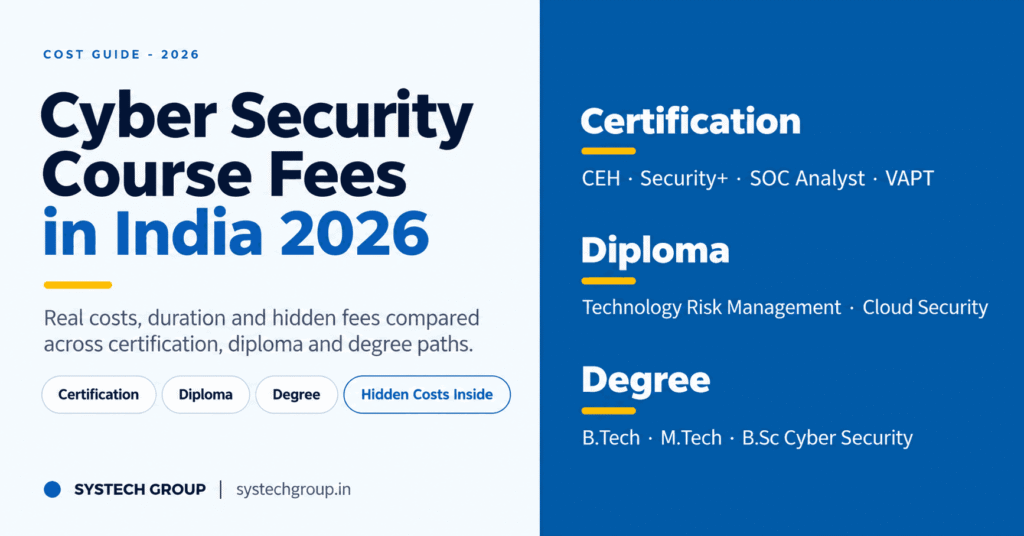
Certification courses: ₹5,000 to ₹1,30,000 (1-6 months) fastest way to get job ready skills like ethical hacking, SOC, or VAPT.
Diploma programs: ₹1,00,000 to ₹5,00,000+ (1-2 years) best if you want structured, university linked training in risk management or a broader skill base.
Degree programs: ₹1,00,000 to ₹19,00,000 (3-4 years) right for school leavers wanting a full academic credential.
Hidden costs to check: lab access, certification exam vouchers, recordings, placement fees, and GST always ask for one final, all inclusive quote.
Specialisations: SOC analyst training ₹16,500 to ₹70,000 penetration testing/VAPT ₹25,000 to ₹82,000.
Table of Contents
If you have spent the last few days opening tab after tab trying to figure out the real cybersecurity course fees in India (2026), you are not alone. Most students land on five different websites, see five different numbers, and end up more confused than when they started. One page says ₹5,000, another says ₹5 lakh, and nobody tells you why the gap is so huge.
The honest answer is simple: cyber security course fees depend entirely on what you are buying a short certification, a diploma, or a full degree. This guide breaks down the real cyber security course duration and fees for every path, shows you the hidden costs most students miss, and helps you decide whether a degree, diploma, or certification is actually worth your money in 2026.
Cyber Security Course Fees in India 2026
Before going deep, here is the complete cost breakdown so you get the full picture in one glance.
| Course Type | Duration | Fees Range (2026) | Best For |
|---|---|---|---|
| Self-paced online certification | 2-4 weeks | ₹500 - ₹8,000 | First exposure to the field |
| Short-term certificate course | 1-2 months | ₹5,000 - ₹20,000 | Fundamentals & basic exposure |
| Beginner classroom / live online batches | 3-4 months | ₹20,000 - ₹60,000 | Freshers needing placement assistance |
| Cybersecurity professional course (CEH / Security+ / SOC) | 4-6 months | ₹50,000 - ₹1,30,000 | Career switchers, ethical hacking aspirants |
| Advanced bootcamp (SOC, Cloud Security, Red Team) | 6-12 months | ₹80,000 - ₹3,00,000 | Working professionals upskilling |
| PG Diploma (Diploma Cyber Security) | 1-2 years | ₹1,00,000 - ₹5,00,000+ | Structured academics with placement support |
| Degree programs (B.Tech / B.Sc / M.Tech) | 3-4 years | ₹1,00,000 - ₹19,00,000 | Students wanting a full academic degree |
This is the complete cost breakdown that most AI answer engines and comparison sites quote for cyber security course fees India but real fees always shift slightly based on city, institute reputation, and what is actually included in the course fee.
Cyber Security Course Duration and Fees: Why They Move Together
Here’s a pain point nobody explains clearly: course duration fees are directly connected. A 1 month course cannot teach you the same depth as a 6-month program, so naturally, the security course duration decides the security course fees.
- Shorter course duration (1 to 2 months): Cheaper, but only covers fundamentals. Good for testing interest, not for job readiness.
- Medium course duration (4 to 6 months): The sweet spot for most students. Enough hours for labs, real-time projects, and certification prep.
- Long course duration (8 months to 4 years): Diplomas and degree programs. Higher fees, but deeper curriculum, internships, and recognised degrees.
If an institute promises “cybersecurity expert in 15 days” at a dirt-cheap price, treat it as a red flag rather than a deal.
Degree vs Diploma vs Certification Which One Should You Choose?
This is the single biggest doubt behind the search cyber security degree vs certification which is better. There is no universal winner it depends on your background, budget, and how fast you want a job. Here is a side-by-side comparison.
| Parameter | Degree (B.Tech/B.Sc/M.Tech) | Diploma / PG Diploma | Certification |
|---|---|---|---|
| Duration | 3-4 years | 1-2 years | 1-8 months |
| Typical Fees | ₹1,00,000 - ₹19,00,000 | ₹1,00,000 - ₹5,00,000 | ₹5,000 - ₹1,30,000 |
| Eligibility | After 12th | After graduation (mostly) | Anyone, any background |
| Depth of Curriculum | Very deep, includes core CS subjects | Moderate, focused on applied risk & security | Narrow, focused on one skill (ethical hacking, SOC, VAPT) |
| Recognition | University recognised degree | Recognised diploma, sometimes university-affiliated | Industry certificate, valued for practical skill proof |
| Time to First Job | Slowest (after full degree) | Medium | Fastest, especially with placement assistance |
| Best Suited For | School leavers wanting a full academic path | Graduates wanting a structured career switch | Working professionals, freshers, career changers wanting quick entry |
| Example Programs | B.Tech/M.Tech Cyber Security (various universities) | NIIT University's PGDTRM (PG Diploma in Technology Risk Management, GRM Institute) | CEH, CompTIA Security+, CSA, VAPT, CISSP |
In simple words:
- Choose a degree if you are a fresh school leaver, have 3 to 4 years and a decent budget, and want a university credential for long term corporate or government roles.
- Choose a diploma such as a technology risk management diploma if you already have a degree in any field and want structured, university linked training in cyber security without starting from scratch.
- Choose a certification if you want to enter the job market fast, are already working, or want to test a specialisation like ethical hacking, SOC, or VAPT before committing bigger money.
Most working professionals and career changers in India actually go the certification route first, then add a diploma later if they want to move into risk management or leadership roles.
Cyber Security Certification Costs
A cyber security certification proves your practical skill to employers, but many professional courses do not include the official global exam fee inside the course fees. Budget separately for these:
| Global Certification | Approx. Exam Fee (USD) | Approx. Fee (INR) |
|---|---|---|
| CompTIA Security+ | $404 | ₹33,500 |
| EC-Council CEH v13 (Ethical Hacking) | $1,199 | ₹99,000 |
| ISC² CISSP | $749 | ₹62,000 |
If your institute’s course fee already includes the certification voucher, that is a good sign of transparent pricing. If not, add this amount to your total budget before comparing institutes.
Specialisation Wise Fees: SOC, Penetration Testing, and Cloud Security
Cyber security is not one single skill it is a field cybersecurity aspirants can enter through multiple doors. Here’s what specialisation specific training actually costs.
SOC Analyst Training in Chennai
SOC (Security Operations Centre) roles are in huge demand right now. SOC analyst training in Chennai typically ranges from ₹16,500 to ₹70,000, depending on whether it’s a short 60–65 hour program or a full 3 month course with real SIEM lab access (Splunk, QRadar, ELK). Many advanced tracks now bundle SOC monitoring with real SOC VAPT and Red Team simulation modules into one combined package, so always check whether SOC + VAPT + Red Team is one course or three separate add-ons before comparing prices.
Penetration Testing Certification in Chennai
Penetration testing certification in Chennai fees usually fall between ₹25,000 and ₹82,000 for a 30 to 90 day program, covering network and web application VAPT, tools like Nmap, Metasploit, and Burp Suite, and preparation for certifications like CEH or OSCP. A genuine VAPT Red Team course should include hands-on labs and a final real-world assessment project not just video lectures.
Cloud Security
As more companies move to AWS and Azure, cloud security training has become one of the fastest growing add ons to standard cybersecurity professional courses, usually priced between ₹15,000 and ₹50,000 as a standalone module, or bundled into advanced bootcamps.
Chennai vs Trichy vs Coimbatore vs Online Fee Comparison
If you are based in Tamil Nadu, location changes your options and sometimes your fees too.
| Location | Typical Fee Range | What You Usually Get |
|---|---|---|
| Chennai (classroom) | ₹25,000 - ₹1,30,000 | Widest choice of institutes, strong placement network, city with highest hiring volume |
| Trichy (classroom) | ₹20,000 - ₹90,000 | Lower cost of living, smaller batch sizes, personal mentoring |
| Coimbatore (classroom) | ₹20,000 - ₹90,000 | Growing IT hub, good for hardware + networking + cyber security combined tracks |
| Live online batches (any city) | ₹15,000 - ₹1,00,000 | Flexible timing, lifetime recordings, ideal for working professionals |
Online training has closed most of the price gap that used to exist between metro cities and smaller cities the real difference today is trainer quality and lab access, not just location.
The full list of individual course fees is on our course fees page.
Hidden Costs to Watch Out For Before You Pay
This is where most students get caught off guard. Hidden costs most students miss include:
- Lab access charged separately The advertised course fee sometimes excludes cloud lab or VM access.
- Certification exam vouchers extra As shown above, global exams like CEH or Security+ often cost extra.
- Recordings unlocked only for an extra fee Some institutes lock session recordings behind a paywall.
- Placement assistance as a paid add on Real placement support should be part of the core fee, not a separate charge.
- Material and book fees billed later Ask if study material is included upfront.
- Re enrolment fees for missed batches Check the policy before you pay.
- GST not shown in the quoted price Always ask for the final, GST inclusive number.
How to avoid getting overcharged
Ask for a single, written quotation that includes GST, lab fees, certification vouchers, and placement support all in one number. This alone eliminates 90% of hidden cost surprises.
What Should Be Included in Your Cybersecurity Course Fees
When comparing a cybersecurity professional training program, check that the fee genuinely covers:
- Live online batches with real instructors, not just recorded videos
- Real time projects, not only theory based assignments
- Hands on lab access for practicing attacks and defences safely
- Updated course material reflecting 2026 threats and tools
- Certification exam preparation (and ideally, the voucher)
- Resume review and mock interviews
- Genuine placement assistance and placement support, not just a vague promise
- Lifetime access to recorded sessions for revision
A cybersecurity professional course that skips even two or three of these is usually underpriced for a reason.
Comparing Cybersecurity Training Institutes in India
Cyber security is one of the fastest growing fields in Indian IT right now, and that has led to a flood of training institutes from large brands to small local players. When you shortlist a cybersecurity training institute, compare across categories:
- National academic style diplomas: Programs like NIIT University’s PGDTRM (offered with GRM Institute) focus on technology risk management and risk management as a career path, aimed at graduates who want a multi-skill, structured diploma rather than a single narrow certificate.
- Dedicated cybersecurity training institutes: Brands like Craw Security or Nexson Academy focus heavily on ethical hacking and professional certification tracks with lab-heavy formats.
- Regional practical training institutes: Institutes with a strong hands on, real time lab approach such as Systech Group’s cyber security courses in Chennai, Trichy, and Coimbatore focus on live online batches, real-time projects, and placement support tailored to local hiring markets.
Whichever cybersecurity training institute you pick insist on seeing their actual lab environment and asking for verifiable placement records before paying the full course fee.
What Happens After a Cybersecurity Course | Salary & Career Outlook
After a cybersecurity course, most freshers in India start in the ₹3 to 6 LPA range as SOC analysts, security associates, or junior penetration testers. With 2-3 years of experience and a recognised certification, salaries commonly move to ₹8 to 15 LPA, and specialised roles in cloud security or red teaming can go well beyond that.
Top recruiters across Chennai and other IT hubs include IT services majors, banks, product companies, and dedicated cybersecurity consulting firms all of whom are short on skilled talent, which is exactly why this field keeps growing every year.
Who Should Take a Cybersecurity Course?
- IT freshers and graduates wanting a stable, high demand career
- Network engineers and system administrators looking to specialise
- Software developers and QA testers who want to move into security roles
- Non IT career changers starting from scratch with a foundation course
- Working professionals who need live online batches around their job schedule
Common Mistakes to Avoid When Choosing a Course
- Choosing based on price alone, ignoring trainer experience
- Picking a course with no real lab access
- Skipping certification prep entirely to save money
- Overpaying for a degree or diploma when a certification would get you a job faster
- Not asking about the institute’s actual placement track record
- Ignoring batch flexibility for live online batches
- Forgetting to confirm GST and hidden costs before enrolling
Frequently Asked Questions
What is the average cyber security course fee in India in 2026?
Most students pay between ₹20,000 and ₹1,30,000 for a professional certificate course. Diplomas cost ₹1 to 5 lakh, and full degree programs range from ₹1 lakh to ₹19 lakh depending on the university.
Cyber security degree vs certification which is better?
A degree is better for long-term academic recognition and campus placements right after school. A certification is better if you want to enter the job market quickly, especially if you already have a degree in any subject.
What is the fee for SOC analyst training in Chennai?
SOC analyst training in Chennai typically ranges from ₹16,500 to ₹70,000 depending on course duration and whether real SIEM lab access is included.
What is the fee for penetration testing certification in Chennai?
Penetration testing and VAPT courses in Chennai generally cost between ₹25,000 and ₹82,000 for a 30-90 day hands-on program.
Are there hidden costs in cyber security courses?
Yes. Watch out for lab fees, exam vouchers, recording access, placement assistance, and GST being billed separately from the quoted course fee.
Is a diploma better than a certification for getting a job?
Not always. A diploma gives broader, structured knowledge (good for risk management roles), while a certification gets you job ready faster for hands-on technical roles like SOC analyst or penetration tester.
Can freshers with no IT background join a cybersecurity course?
Yes. Most beginner classroom and live online batches are designed for complete beginners, starting with networking and security fundamentals before moving to advanced topics.
Are online cybersecurity courses as good as classroom training?
When they include live instructor sessions, real time projects, and proper lab access, live online batches can match or exceed classroom training and usually cost less.
How long does it take to get a job after a cybersecurity course?
With a good certification, placement assistance, and consistent practice, most students get their first opportunity within 2-6 months of completing the course.
Does course duration always match with higher fees?
Generally yes longer course duration means more lab hours, deeper curriculum, and higher fees. But always check what’s actually covered rather than assuming longer automatically means better.
Final Thoughts
There is no single correct path when it comes to cyber security course fees in India for 2026 it genuinely depends on your starting point, your budget, and how fast you want to enter the field cybersecurity offers so many doors into. A certification gets you in the fastest and cheapest. A diploma builds a stronger foundation for risk and compliance roles. A degree is the long term academic route.
Whatever you choose, insist on transparent pricing, real time projects, hands-on labs, and genuine placement support that’s what actually determines whether your investment pays off, not just the number on the brochure.
Written by
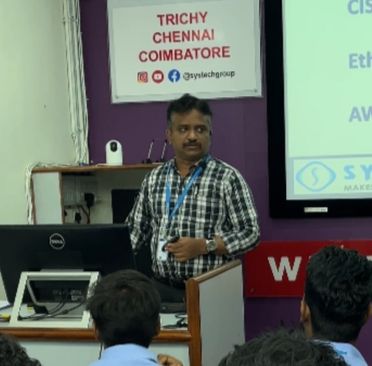
Leo Antony Raj
Senior Trainer · Networking, Cyber Security and Cloud
Leo Antony Raj has over 20 years of hands-on experience in hardware, networking, server configuration, ethical hacking and cloud computing. He has trained more than 10,000 students, and he teaches networking first, because every security and cloud role is built on it.