By Arjun Kumar, Senior Trainer, Systech Group 15+ years in Network Security and Cloud Architecture · Updated October 2026.
6 min read
In short
Cloud computing courses after BCA fall into three groups: cloud certifications (AWS, Microsoft Azure, Google Cloud), job-oriented cloud and DevOps training, and postgraduate degrees such as MCA or M.Sc. For the fastest route into a cloud job, pick one platform, earn its beginner certification, and build hands-on projects with Linux, networking and scripting.
Table of Contents
Introduction
Completing your BCA is a significant milestone, but the real challenge begins when you ask: What next? Many graduates find themselves stuck in low-paying jobs or endless job applications with no response. The reason? A gap in industry-relevant skills. That’s where cloud computing courses after BCA come in.
With over 90% of enterprises now using cloud infrastructure, demand for skilled professionals is skyrocketing. These courses bridge the gap between academic knowledge and real-world IT demands. By mastering cloud platforms like AWS, Azure and Google Cloud, you position yourself for high-growth roles in DevOps, cloud security, and solution architecture. This blog will guide you through the future scope of cloud computing after BCA, the cloud computing career path after BCA, and the abundant cloud computing job opportunities available today.
What You’ll Learn
- Why are cloud computing courses after BCA the fastest route to a high-paying IT job?
- How is the future scope of cloud computing after BCA expanding globally?
- Step-by-step cloud computing career path after BCA, from entry-level to leadership roles.
- Real-world cloud computing job opportunities across sectors like finance, healthcare, and e-commerce.
- Top certifications and hands-on skills you’ll gain during training.
Why Cloud Computing is the Next Logical Step After BCA
BCA graduates have a solid foundation in programming, databases, and networking skills that directly align with cloud computing. However, academic curricula often lack exposure to modern cloud platforms. This is where specialised training becomes essential.
From Theory to Practice
While BCA teaches C, Java, and SQL, cloud computing applies these skills to real environments. For example, you’ll use Python to automate cloud deployments or SQL to manage cloud-hosted databases. This practical application makes you job-ready faster than traditional postgraduate degrees.
Industry Demand for Cloud Skills
According to NASSCOM, India will need over 4 million cloud professionals by 2026. Companies are actively hiring BCA graduates who have completed cloud computing courses after BCA because they offer cost-effective, skilled talent.
Future Scope of Cloud Computing After BCA
The future scope of cloud computing after BCA is not just promising, it’s explosive. Cloud adoption is no longer optional; it’s mandatory for business survival.
Global and Local Growth Trends
- The global cloud market is projected to reach $1.5 trillion by 2030.
- Indian startups and IT firms are migrating legacy systems to the cloud.
- Government initiatives like Digital India rely heavily on cloud infrastructure.
Emerging Areas in Cloud Computing
- Multi-cloud and hybrid cloud environments Companies use multiple providers for redundancy.
- Serverless computing Reduces infrastructure costs and speeds up deployment.
- AI-powered cloud analytics Enables real-time decision-making in business.
This growth ensures that BCA graduates with cloud skills will remain in high demand for decades.
Cloud Computing Career Path After BCA
The cloud computing career path after BCA is well-defined and scalable. You can start as a fresher and grow into leadership roles within 5–7 years.
Entry-Level Roles (0-2 Years)
- Cloud Support Associate – Troubleshoot cloud issues and assist in deployments.
- Junior Cloud Administrator – Manage user access, storage, and basic configurations.
- Cloud Migration Assistant – Help transfer data and applications to cloud platforms.
Average starting salary: ₹3.5-5 LPA.
Mid-Level Roles (2-5 Years)
- DevOps Engineer – Automate deployment pipelines using tools like Jenkins and Docker.
- Cloud Security Analyst – Implement firewalls, encryption, and compliance checks.
- Cloud Solution Architect – Design scalable and secure cloud systems for clients.
Average salary: ₹8-15 LPA.
Senior-Level Roles (5+ Years)
- Cloud Consultant – Advise enterprises on cloud strategy and cost optimisation.
- IT Infrastructure Manager – Oversee entire cloud operations across departments.
- Cloud Product Manager – Lead development of cloud-based software products.
Average salary: ₹18 – 30+ LPA.
Cloud Computing Job Opportunities
The cloud computing job opportunities for BCA graduates are vast and growing.
Sectors Hiring Cloud Professionals
- IT Services – TCS, Infosys, and Wipro hire cloud specialists for client projects.
- Banking & Finance – Banks use cloud for fraud detection and customer data management.
- Healthcare – Cloud platforms store patient records securely and enable telemedicine.
- E-commerce – Companies like Flipkart and Amazon rely on the cloud for scalability during sales.
Job Portals and Hiring Trends
Platforms like Naukri, LinkedIn, and Indeed show over 50,000 active listings for cloud roles in India. Keywords like “AWS,” “Azure,” and “cloud administrator” appear in 70% of IT job descriptions.
Essential Skills You’ll Gain from Cloud Computing Courses
Cloud computing courses help you build industry-relevant, job-ready skills that match how modern businesses design, deploy, and manage digital infrastructure today. You gain practical exposure to real-world tools, cloud platforms, workflows, and best practices used across startups, enterprises, and global tech teams.
Technical Skills
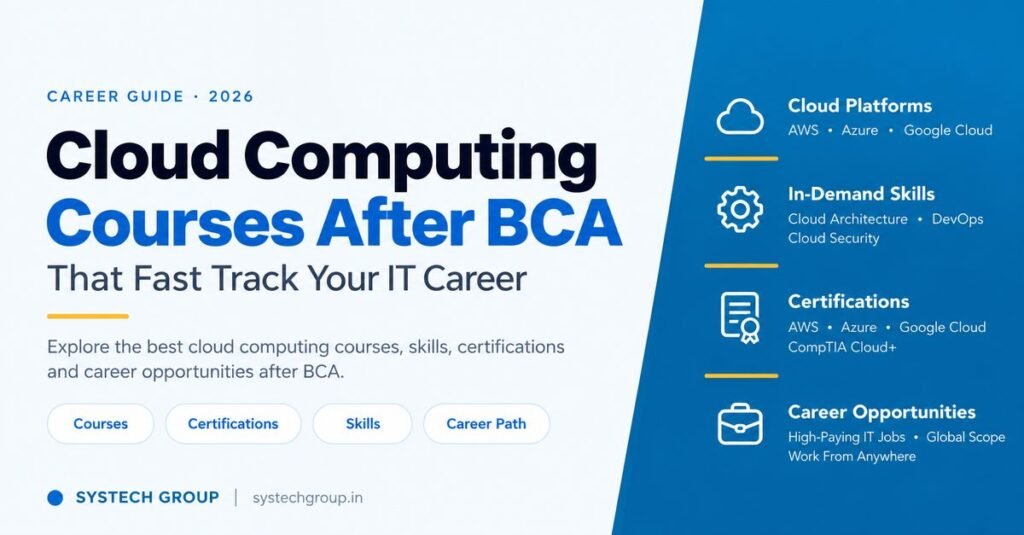
- Cloud Platforms: Master AWS, Azure, and Google Cloud Console.
- Networking in Cloud: Configure VPCs, subnets, and load balancers.
- Security & Compliance: Implement IAM policies, encryption, and GDPR standards.
- Automation: Use scripts (Python, Bash) to automate repetitive tasks.
Soft Skills
- Problem-Solving: Diagnose and fix cloud outages quickly.
- Team Collaboration: Work with developers, security teams, and managers.
- Client Communication: Explain technical cloud concepts to non-technical stakeholders.
Recommended Certifications After BCA
Certifications validate your skills and boost employability.
AWS Certified Solutions Architect - Associate
Covers designing distributed systems on AWS. Recognised globally and highly valued.
Microsoft Certified: Azure Fundamentals (AZ-900)
Ideal for beginners. Covers cloud concepts, Azure services, and security.
Google Cloud Associate Cloud Engineer
Focuses on deploying and monitoring cloud applications on GCP.
CompTIA Cloud+
Vendor-neutral certification covering cloud infrastructure and operations.
Course Modules Overview
Module 1 - Cloud Fundamentals
- Introduction to cloud computing.
- Public, private, and hybrid cloud models.
- Cloud service models: IaaS, PaaS, SaaS.
Module 2 - Major Cloud Platforms
- AWS: EC2, S3, RDS, Lambda.
- Azure: Virtual Machines, Blob Storage, Functions.
- Google Cloud: Compute Engine, Cloud Storage, BigQuery.
Module 3 - Cloud Security
- Identity and Access Management (IAM).
- Data encryption and compliance (GDPR, HIPAA).
- Threat detection and incident response.
Launch Your Cloud Computing Career After BCA
Building a successful career in cloud computing after BCA is easier with expert-led cloud computing training at Systech Group. Our program equips students with the right technical skills, hands-on knowledge and career readiness to thrive in today’s competitive IT landscape.
At Systech Group, students benefit from:
- Personalised Resume Reviews – Tailored feedback to showcase cloud projects and skills effectively.
- Mock Technical Interviews – Practice sessions with cloud experts to boost confidence and technical clarity.
- Career Readiness Training – Focused sessions designed to prepare students for real-world challenges in the IT industry.
Not sure which route fits you?
Tell us your stream and what you are hoping for, and we will tell you honestly which option suits.
Get course detailsConclusion
The future scope of cloud computing after BCA is bright, with endless cloud computing job opportunities across industries. By enrolling in cloud computing courses after BCA, you gain the skills, certifications, and confidence to launch a successful IT career. Whether you aim to become a Cloud Architect, DevOps Engineer, or Security Analyst, the path starts with the right training. Get in touch with our team today and become a part of the cloud revolution.
Frequently asked questions
Which Cybersecurity courses are best for freshers after a BSc?
Beginner-friendly certifications like CompTIA Security+ and CEH are excellent starting points for freshers. These courses help build core security knowledge before advancing into specialised areas.
Can I do Cybersecurity after a BSc Computer Science without extra programming knowledge?
Yes, absolutely. A BSc Computer Science background gives you a solid technical base, and most Cybersecurity courses include any additional scripting skills required.
What is the average salary after starting a Cybersecurity career with a BSc?
Entry-level Cybersecurity professionals can earn between ₹4 LPA and ₹8 LPA, depending on skills, certifications, and job role. Higher specialised roles offer greater salary growth.
How long does Cybersecurity training usually take after a BSc?
Course duration varies by learning path. Certification-based courses may take around 3 months, while advanced diploma training can extend up to 12 months.
Is certification from a Cybersecurity Training Institute valuable for jobs?
Yes, certifications from a reputed Cybersecurity Training Institute are highly valued when combined with practical skills, hands-on lab training, and recognised industry credentials.
Can I do cybersecurity after BSc Maths, Physics or Chemistry?
Yes. Most cybersecurity certifications and diploma courses do not ask for a Computer Science degree. If you studied Maths, Physics or another science subject, spend two to three months on networking, Linux and basic scripting first. Then join a course such as CompTIA Security+, SOC analyst training or ethical hacking. MSc eligibility depends on the university.
Is an MSc in Cybersecurity better than a certification after BSc?
It depends on your goal. An MSc gives a two-year degree and theory, which helps for research, teaching and some government or academic roles. Certifications and lab-based training are faster, from a few weeks to about a year, and build the tool skills that SOC and penetration testing jobs check in interviews. Many students combine both.
Which should I do first after BSc, CEH or Security+?
Security+ is the better first step for most BSc freshers because it covers the basics: threats, networks, cryptography, identity and risk. Do CEH when you want an ethical hacking or penetration testing career. EC-Council asks for official CEH training or two years of security experience, so freshers usually join an approved training programme.
Are there free cybersecurity courses for BSc graduates?
Yes. Cisco Networking Academy offers a free, self-paced Junior Cybersecurity Analyst path of about 120 hours. It prepares you for the Cisco CCST Cybersecurity certification. Free courses are good for testing your interest. Instructor-led labs, mentor feedback and interview practice usually come from a paid training programme.
Which cybersecurity course with placement assistance is best after BSc?
Pick the course that matches your target role and offers hands-on labs, a trainer with real industry experience, and structured placement support such as resume review and mock interviews. Be careful with 100 percent job guarantee claims, because no genuine institute can guarantee a job. Systech Group offers placement assistance with its cybersecurity training.
Can I get a government job in cybersecurity after BSc?
Yes, but eligibility depends on each notification. Many government cybersecurity roles ask for a specific degree, such as BE/BTech, MCA or MSc, or for certifications, and are filled through recruitment exams or contracts. An MSc plus certifications such as CEH or Security+ widens your options. Read [how government cybersecurity roles are filled] for details.
Can I do CISSP right after BSc?
Not the full CISSP. ISC2 asks for about five years of paid security experience. After a BSc you can still pass the exam and become an Associate of ISC2, then earn the full certification as you gain experience. Start with Security+ or SOC analyst training first.