
By Leo Antony Raj, Senior Trainer, Systech Group 20+ years in networking and cybersecurity · Updated November 2026.
6 Min read
In short
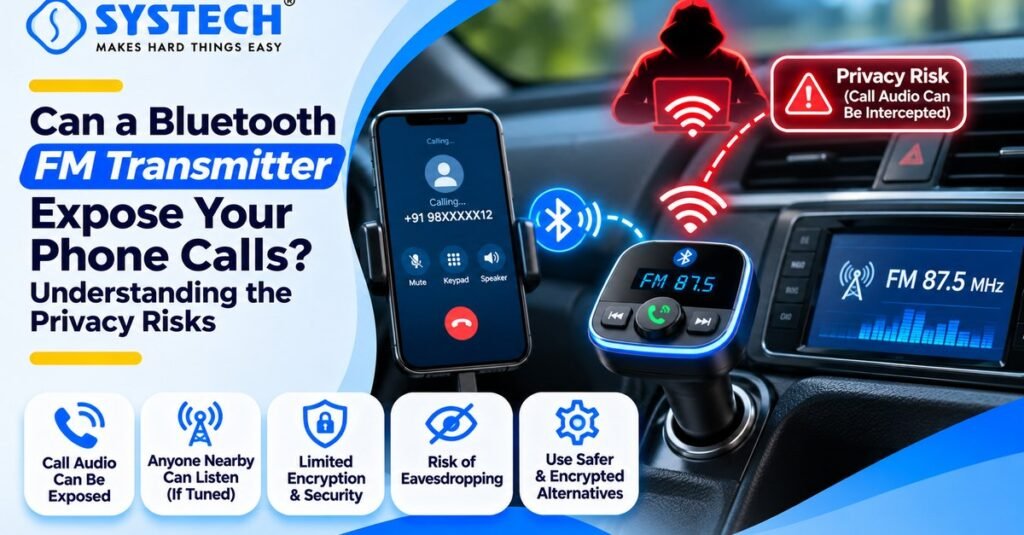
A Bluetooth FM transmitter receives audio from a paired phone over Bluetooth and rebroadcasts it on a selected FM frequency so a nearby compatible radio can play it. If the transmitter routes hands-free phone-call audio through the FM connection, another compatible radio tuned to the same frequency may be able to receive that broadcast when it is within usable signal range. Bluetooth pairing security does not encrypt the separate FM broadcast. This does not mean calls are automatically exposed over a long distance; reception depends on the transmitter, antenna, distance, interference and local conditions. For sensitive calls, use a personal headset or wired audio connection instead of FM rebroadcasting.
Table of Contents
Can a Bluetooth FM Transmitter Expose Your Phone Calls?
Yes, under specific conditions. If a Bluetooth FM transmitter sends phone-call audio over a selected FM frequency, a compatible radio tuned to that same frequency may receive the broadcast if it is within the usable signal area. This creates a possible privacy exposure because the FM transmission is a separate wireless link from the Bluetooth connection between your phone and the transmitter.
The important point is that Bluetooth and FM perform different jobs in this setup. Bluetooth carries audio from the phone to the transmitter. The transmitter then sends the audio over an FM frequency so a car stereo or another compatible radio can play it. Securing the Bluetooth pairing does not automatically secure the FM broadcast.
However, this should not be described as guaranteed long-distance eavesdropping. A receiver must be compatible, tuned to the same frequency and close enough to receive a usable signal. Actual reception depends on the transmitter’s output, antenna placement, distance, interference and local radio conditions.
The Two Wireless Links
PHONE → BLUETOOTH → FM TRANSMITTER → FM BROADCAST → CAR RADIO
This simplified signal path is the central concept behind the privacy concern described in the supplied brief. Understanding how connected devices communicate and exchange data is also an important part of practical networking knowledge covered in a CCNA training institute in Chennai with practical networking labs.
How Does a Bluetooth FM Transmitter Work?
A Bluetooth FM transmitter is a small car accessory that allows a phone to send audio to a vehicle radio that may not have built-in Bluetooth audio support. The phone pairs with the transmitter over Bluetooth. The transmitter then broadcasts the received audio on a selected FM frequency.
Pair the phone with the Bluetooth FM transmitter.
Choose an available FM frequency on the transmitter.
Tune the car stereo to the same frequency.
Play music, navigation audio or supported hands-free call audio from the phone.
The transmitter sends the audio over FM, and the car radio receives and plays it.
The exact functions vary by product. Some transmitters support music playback only, while others include a microphone and hands-free calling features. Check the product manual to confirm whether phone calls are routed through the FM transmitter.
Why Use an FM Transmitter?
It can add wireless audio playback to a car stereo without built-in Bluetooth audio.
It can provide hands-free calling on models that support a microphone and call controls.
It can transmit navigation prompts and other phone audio to the car speakers.
It can be a convenient option for older vehicles with a working FM radio.
How Hands-Free Phone-Call Audio Reaches the Car Radio
When a compatible transmitter supports hands-free calling, it may receive call audio from the paired phone over Bluetooth. The transmitter then sends that audio to the car stereo through its selected FM frequency. The vehicle radio receives the FM signal and plays the sound through the speakers.
A typical call-audio path looks like this:
A phone call arrives or the user places a call on the paired smartphone.
The phone routes call audio to the connected Bluetooth hands-free device.
The FM transmitter receives the supported call audio.
The transmitter rebroadcasts the audio on its selected FM frequency.
The car stereo tuned to that frequency plays the call audio.
Some devices may use a built-in microphone to capture the driver’s voice and send it back through the Bluetooth connection to the phone. The precise microphone and call-routing design depends on the model. Do not assume that every Bluetooth FM transmitter supports calls or handles microphone audio in the same way.
The Jabra FREEWAY manual included in the supplied research describes routing phone calls, music and GPS directions to a car stereo over a selected FM frequency. This supports the audio-routing explanation, but it is not evidence that every model has the same implementation or that a particular device is vulnerable. Understanding these communication processes also builds a foundation for networking concepts taught in a CCNA course in Trichy with hands-on Cisco lab training.
Bluetooth Encryption vs FM Broadcast Privacy
A common misunderstanding is to assume that because a phone is paired securely with the transmitter, every later part of the audio path is also private. That is not necessarily true. Security must be considered across the complete path from the phone to the final audio receiver, which is an important concept explored through Cybersecurity training in Chennai with practical ethical hacking sessions.
A common misunderstanding is to assume that because a phone is paired securely with the transmitter, every later part of the audio path is also private. That is not necessarily true. Security must be considered across the complete path from the phone to the final audio receiver.
Not sure which route fits you?
Tell us your stream and what you are hoping for, and we will tell you honestly which option suits.
Get course detailsWhen Could Someone Else Hear the Call?
Another person may be able to hear the call audio only when several practical conditions align. The receiver must support FM reception, be tuned to the same frequency and be within the usable reception area of the transmitter. The broadcast must also be carrying the call audio at that time.
The FM transmitter is actively sending the phone-call audio.
Another compatible FM radio is tuned to the same selected frequency.
The other radio is within a location where the signal can be received clearly enough.
The transmitter and surrounding radio conditions allow the signal to be received.
The transmitter model actually routes hands-free call audio through FM.
This is a conditional exposure scenario, not proof that anyone nearby can automatically listen to every call. The supplied brief does not provide a measured interception distance or a specific transmitter model with verified range results. Avoid quoting a universal distance or claiming that calls can be heard across a large area.
What Affects FM Transmitter Signal Range?
The usable reception area varies by transmitter and environment. The supplied brief identifies several factors that can affect whether another radio receives the signal.
Because these variables differ, there is no single reliable reception distance that applies to every Bluetooth FM transmitter. Use the manufacturer’s documentation for device-specific information and do not treat a range estimate from another model as universal.
Realistic Privacy Risks and Limitations
The main privacy concern is the separate FM broadcast, not the mere fact that Bluetooth is enabled. If a transmitter rebroadcasts call audio, a compatible receiver may be able to receive it under the conditions described above. This is why an FM transmitter should not be treated as a private audio channel for confidential conversations, making wireless security an important topic in a Cybersecurity course in Coimbatore with hands-on practical training
The risk should be explained accurately. The available source material supports the possibility of receiving the FM audio under suitable conditions. It does not establish a guaranteed interception range, widespread real-world exploitation or a universal weakness in all Bluetooth FM transmitters.
How to Improve Bluetooth and In-Car Privacy
You can reduce privacy exposure by choosing suitable audio equipment, managing Bluetooth connections and avoiding FM rebroadcasting for confidential conversations.
Avoid FM rebroadcast for sensitive calls. Use a personal headset or a wired audio connection when the conversation contains confidential or personal information.
Pair only with trusted devices. Check the device name before confirming a Bluetooth pairing request.
Remove old Bluetooth pairings. Delete devices you no longer use, especially from phones and shared vehicle systems.
Disable Bluetooth discovery when it is not needed. This reduces unnecessary visibility to nearby devices, depending on the phone’s operating system and Bluetooth behaviour.
Review connected-device lists. Remove unknown or obsolete devices from the phone and transmitter where the product supports this.
Check the transmitter’s call-routing behaviour. Read the manual and confirm whether hands-free call audio is transmitted over FM.
Use a wired connection when practical. A suitable wired audio path avoids rebroadcasting call audio over the FM frequency.
Keep devices updated. Install supported phone operating-system and accessory firmware updates where available.
Clear data from shared or rental vehicles. Remove personal Bluetooth pairings and stored contacts or call information when returning a shared vehicle.
Do not discuss sensitive information over an audio path you do not understand. Choose a private headset or another suitable communication method.
Bluetooth Privacy Checklist
Safer Options for Private Phone Calls
If call privacy is important, choose an audio connection that is designed for personal listening rather than broadcasting audio over an FM frequency.
For confidential calls, a personal headset or wired connection is the safer recommendation in the context of the risk described in this article. Built-in vehicle Bluetooth removes the separate FM broadcast, but users should still manage pairing and clear personal data from shared vehicles.
Frequently asked questions
Can others hear my calls through a Bluetooth FM transmitter?
They may be able to receive the call audio if the transmitter broadcasts it over FM, their radio is tuned to the same frequency and they are within usable signal range. It is not guaranteed or necessarily long-distance.
Does Bluetooth encryption protect calls sent through an FM transmitter?
Bluetooth security applies to the phone-to-transmitter connection. It does not automatically encrypt the separate FM broadcast from the transmitter to a radio.
How does a Bluetooth FM transmitter send phone-call audio?
A supported transmitter receives call audio from the paired phone over Bluetooth and rebroadcasts it on a selected FM frequency for a compatible car radio to play.
Can a normal FM radio receive the transmitter's signal?
A compatible FM radio may receive it if it is tuned to the same frequency and is within the usable reception area.
How far can someone hear a Bluetooth FM transmitter?
There is no universal distance. Reception depends on transmitter output, antenna placement, distance, interference, device design and local radio conditions.
Are all Bluetooth FM transmitters vulnerable?
The article does not establish that every model has the same exposure. The risk depends on whether the model routes call audio through FM and on its signal and operating conditions.
Can someone hear only music, or phone calls too?
A transmitter may broadcast music, navigation prompts and hands-free call audio if its model supports those functions. Check the product manual for call-audio support.
Is a built-in car Bluetooth system more private than an FM transmitter?
It avoids the separate FM rebroadcast step, which removes the specific FM exposure discussed here. Bluetooth pairing and stored vehicle data still need to be managed.
What is the safest way to make a private call in a car?
Use a personal headset or a suitable wired audio connection for sensitive conversations rather than routing the call through an FM transmitter.
What should I do before returning a rental car with Bluetooth?
Remove your phone from the vehicle’s paired-device list and clear stored contacts or call information where the system allows it. Also remove the vehicle pairing from your phone if you no longer need it.
Learn Networking and Cybersecurity with SYSTECH Group
Wireless communication security is connected to networking fundamentals, device authentication, data privacy and secure configuration. Learning how Bluetooth, wireless networks and connected devices communicate helps build a stronger understanding of practical cybersecurity, including concepts covered in a Cybersecurity training institute in Trichy for ethical hacking and network security
Final Thoughts
A Bluetooth FM transmitter can create a call-privacy concern when it routes hands-free audio from a paired phone to a selected FM frequency. The phone-to-transmitter Bluetooth connection and the transmitter-to-radio FM broadcast are separate wireless links. Bluetooth security does not automatically encrypt the FM broadcast.
A compatible radio tuned to the same frequency may receive the broadcast when it is within usable signal range, but actual exposure depends on the device and local conditions. It is not accurate to claim that every call is exposed over a long distance. For confidential conversations, use a personal headset or wired audio connection, manage Bluetooth pairings carefully and clear personal data from shared or rental vehicles.
Written by
Leo Antony Raj
Senior Trainer · Networking, Cyber Security and Cloud
Leo Antony Raj has over 20 years of hands-on experience in hardware, networking, server configuration, ethical hacking and cloud computing. He has trained more than 10,000 students, and he teaches networking first, because every security and cloud role is built on it.