By Leo Antony Raj, Senior Trainer, Systech Group 20+ years in Network Security and Cloud Architecture | Updated October 2026.
7 min read
In short
After BCA, you can build a cybersecurity career through short job oriented courses such as Ethical Hacking, SOC Analyst or Network Security training, industry certifications like CompTIA Security+, CEH or CCNA, or a 2-year postgraduate degree such as an MCA or M.Sc in Cyber Security. Most freshers start with networking, Linux and Python, practise in labs, then earn one entry-level certification.
Cybersecurity is no longer an optional skill but a necessity in today’s tech-driven world. For BCA graduates, pursuing a career in cybersecurity opens doors to high-paying jobs, global opportunities, and impactful roles in protecting digital ecosystems.
Table of Contents
Cyber Security After BCA: Your Ultimate Career Guide
Here is a quick comparison of the main options for BCA graduates. Durations are typical and vary by institute.
| Course | Typical Duration | Best for | Leads to roles like |
|---|---|---|---|
| MCA in Cyber Security | 2 years | Academic depth and long-term growth | Security Engineer, Researcher |
| M.Sc Cyber Security | 2 years | Security-focused specialisation | Security Analyst, Researcher |
| PG Diploma in Cyber Security | 6 to 12 months | Faster entry with structured learning | Cybersecurity Analyst |
| Ethical Hacking / Penetration Testing | 3 to 9 months | Testing systems for weaknesses | Ethical Hacker, Penetration Tester |
| SOC Analyst Training | 3 to 6 months | Security monitoring and incident response | Junior SOC Analyst |
| Network Security | 3 to 6 months | Protecting networks and firewalls | Network Security Engineer |
| Cloud Security | 3 to 6 months | AWS, Azure and Google Cloud security | Cloud Security Analyst |
| Digital Forensics | 6 to 12 months | Cybercrime investigation | Forensic Analyst |
MCA and M.Sc eligibility varies by university, so check each programme's criteria.
The rise of technology has brought significant advancements but has also opened doors to a new wave of cyber threats. For students who have completed their BCA, cyber security after BCA emerges as a highly promising and rewarding career path. With companies worldwide investing heavily in digital security, there has never been a better time to consider this field.
In this guide, we’ll explore why cyber security is an excellent career option, how to get started, and the courses that can enhance your skills as a professional.
Why Choose Cyber Security After BCA?
Graduating with a BCA provides a strong foundation in programming, data management, and networking all critical for a career in cyber security. Here’s why pursuing cyber security after BCA is a smart move:
- High Demand for Professionals: Cyber security experts are needed across all industries, from finance to healthcare.
- Lucrative Salaries: The BCA cyber security salary for entry-level roles ranges from ₹4-6 LPA, with experienced professionals earning upwards of ₹15-20 LPA.
- Global Opportunities: Cyber security skills are in demand worldwide, allowing professionals to work abroad or remotely.
- Challenging & Rewarding Work: Whether you’re tackling security breaches or building defense mechanisms, the job is intellectually stimulating.
Best Additional Courses for BCA Students to Pursue Cyber Security
If you’re wondering, “After BCA which course is best?” here are the top options to enhance your skills in cyber security:
Ethical Hacking
Ethical hacking involves identifying vulnerabilities in systems to prevent malicious attacks. BCA cyber security and ethical hacking are closely linked as ethical hackers play a crucial role in securing IT infrastructure.
- How to Become an Ethical Hacker After BCA:
Start by learning programming languages like Python and Java. Then, enroll in certifications such as CEH (Certified Ethical Hacker) to gain practical knowledge.
Network Security
This course focuses on protecting networks from unauthorized access and cyber threats. For those wondering, “After BCA which course is best?” network security is an excellent foundational program.
- Key Skills You’ll Learn: Firewall configuration, VPN setup, and network monitoring tools.
SOC Analyst Training
A SOC (Security Operations Center) analyst course teaches you to monitor alerts, analyse logs and respond to incidents using SIEM tools.
- Key Skills You’ll Learn: log analysis, SIEM tools such as Splunk, threat detection and incident response.
- Typical Duration: 3 to 6 months.
- Roles: Junior SOC Analyst, Incident Response Analyst.
Cloud Security
Cloud security covers protecting workloads, identities and data on AWS, Azure and Google Cloud.
- Key Skills You’ll Learn: identity and access management, network security groups, encryption and cloud monitoring.
- Typical Duration: 3 to 6 months.
- Best After: you’ve learned networking basics.
Cybersecurity Fundamentals
If you’re new to the field, start with a course in cybersecurity fundamentals. These courses answer the common question: “Can we do cyber security after BCA?”
- Topics Covered: Types of cyber threats, data protection techniques, and risk management.
- Certifications: CompTIA Security+ and Cisco CyberOps.
Digital Forensics
Digital forensics trains you to collect and analyse evidence from devices and networks after a cyber incident.
- Key Skills You’ll Learn: disk and memory forensics, evidence handling and report writing.
- Typical Duration: 6 to 12 months.
- Roles: Forensic Analyst, Cybercrime Investigation Support.
Master’s in Cyber Security
Can I do a master’s in cyber security after BCA? Absolutely! A Master’s program equips you with advanced skills in cryptography, forensic analysis, and risk management.
- Why Consider This Option?
For those asking, “Can I become cyber security after BCA?” pursuing a Master’s degree significantly boosts career opportunities. Universities in India and abroad offer tailored Master’s programs for BCA graduates.
Certifications Worth Considering After BCA
| Certification | Level | Focus | Good for |
|---|---|---|---|
| CompTIA Security+ | Entry | Threats, risk management, network security | First security certification |
| Cisco CCNA | Entry to intermediate | Networking fundamentals | Strong network base |
| eJPT | Entry | Practical penetration testing | Hands-on beginners |
| CEH (Certified Ethical Hacker) | Intermediate | Hacking techniques and attack vectors | Ethical hacking roles |
| Cisco CyberOps Associate | Entry | SOC operations and threat analysis | SOC careers |
| OSCP | Advanced | Hands-on penetration testing | Experienced pentesters |
| Cloud security certifications (e.g. Microsoft SC-900, SC-200) | Entry to intermediate | Cloud security basics and operations | Cloud security roles |
CISSP and CISM suit later career stages, because they typically need several years of work experience.
Which Cyber Security Course Should You Choose After BCA?
| Your goal | Best-fit option | Why |
|---|---|---|
| Get a job quickly | SOC Analyst training plus Security+ | Short, job-oriented, entry-level roles |
| Become a penetration tester | Ethical Hacking plus eJPT or CEH | Hands-on testing skills |
| Work with networks and firewalls | Network Security plus CCNA | Strong networking base |
| Work in the cloud | Cloud Security | AWS and Azure demand |
| Build academic depth | MCA or M.Sc in Cyber Security | Postgraduate credential |
| Investigate cybercrime | Digital Forensics | Evidence analysis skills |
If you’re short on time or budget, start with one fundamentals course plus free labs, then add a certification later.
Skills You Need for Cyber Security After BCA
Your BCA already gives you programming and database basics. These are the skills employers look for next:
Networking: TCP/IP, DNS, firewalls and VPNs.
Operating systems: Linux administration and Windows basics.
Scripting: Python, Bash or PowerShell to automate security tasks.
Security tools: Wireshark, Nmap, Kali Linux, Burp Suite and SIEM tools.
Hands-on labs: practice on platforms like TryHackMe and Hack The Box, or build a small home lab.
You don’t need advanced coding for every role. Basic scripting is enough for most analyst jobs, while application security roles need stronger programming.
Cyber Security Roadmap After BCA for Freshers
The simplest sequence is: networking → Linux → Python → security fundamentals → hands-on labs → one entry-level certification → internship or projects.
| Stage | Focus | Approx. Time |
|---|---|---|
| 1 | Networking basics | 1 to 2 months |
| 2 | Linux and Windows | 1 to 2 months |
| 3 | Python or Bash scripting | 1 to 2 months |
| 4 | Security fundamentals and tools | 2 to 3 months |
| 5 | Labs and small projects | Ongoing |
| 6 | One entry-level certification | 1 to 2 months |
| 7 | Internships and job applications | 3+ months |
Most freshers need roughly 6 to 12 months of focused learning to become job-ready, depending on their starting point.
Entry-Level and Growth Roles After BCA
| Role | What you do | Good starting point |
|---|---|---|
| Junior SOC Analyst | Monitor alerts and triage incidents | SOC training plus Security+ |
| Cybersecurity Analyst | Detect threats and apply security controls | Fundamentals plus Security+ |
| Penetration Tester / Ethical Hacker | Test systems for weaknesses | Ethical Hacking plus eJPT or CEH |
| Vulnerability Analyst | Scan systems and track fixes | Network Security plus tools practice |
| Incident Response Analyst | Contain and investigate breaches | SOC training plus forensics basics |
| Network Security Engineer | Manage firewalls and secure networks | CCNA plus Network Security |
| Digital Forensics Analyst | Collect and analyse digital evidence | Digital Forensics course |
| Cloud Security Analyst | Secure cloud accounts and workloads | Cloud Security plus a cloud certification |
| Application Security Analyst | Review code and test applications | Strong programming plus secure coding |
How to Become a Cyber Security Expert After BCA
Becoming a cybersecurity expert requires a systematic approach. Follow these steps to kickstart your career:
Step 1: Build Your Foundation
Enroll in foundational courses that cover topics like ethical hacking, cryptography, and network security.
Step 2: Earn Relevant Certifications
Enroll in certifications like CEH, CISSP, or CompTIA Security+ to gain industry-recognized credentials.
- Why It Matters: Certifications make your resume stand out and give you practical expertise.
Step 3: Gain Practical Experience
Participate in internships, bug bounty programs, or lab simulations to gain hands-on experience.
Step 4: Specialize
Consider pursuing advanced courses, certifications, or a master’s in cybersecurity after BCA to deepen your knowledge and specialize in areas like threat analysis or forensic security.
Benefits of CyberSecurity Courses After BCA?
Pursuing cyber security after BCA offers numerous benefits:
- Lucrative Salaries: High-paying roles in leading industries.
- Global Opportunities: The skills are in demand worldwide.
- Growth Potential: Rapid advancements ensure career growth.
- Flexibility: Freelance or remote work opportunities.
These benefits make BCA cybersecurity and ethical hacking a perfect career choice for tech enthusiasts.
Job Opportunities and BCA Cyber Security Salary
There are diverse job roles available for cybersecurity professionals, including:
- Ethical Hacker
- Security Analyst
- Network Security Engineer
- Forensic Analyst
BCA Cyber Security Salary:
- Entry-Level: ₹4-6 LPA
- Mid-Level: ₹10-15 LPA
- Senior Roles: ₹20 LPA+
Not Sure Which Course to Pick?
The right course depends on your goal, your time and your budget. If you’re a fresher, start with fundamentals. If you already know networking, a specialised track like SOC or ethical hacking may fit better. Systech Group trains students in Chennai, Coimbatore and Trichy with lab-based Cyber Security and Ethical Hacking courses. Share your background and goal with our counsellors, and book a free demo class to see the training first.
Conclusion
- Courses: SOC Analyst, Ethical Hacking, Network Security, Cloud Security, Digital Forensics, or an MCA/M.Sc.
- Certifications: Security+, CCNA, eJPT and CEH for freshers.
- Skills: networking, Linux, Python and hands-on labs.
- Roles: SOC Analyst, Cybersecurity Analyst, Penetration Tester and more.
- Roadmap: learn the basics first, practise in labs, then add one certification.
Frequently asked questions
What Are the Most Important Skills for a Cybersecurity Job in the Government Sector?
To thrive in government cybersecurity roles, professionals must possess a mix of technical and soft skills. Here are some of the most important competencies:
- Network Security: Understanding firewalls, intrusion detection systems (IDS), and secure network configurations is essential for protecting sensitive data.
- Risk Management: The ability to identify, assess, and mitigate risks is critical. Cybersecurity professionals must implement strategies to manage vulnerabilities effectively.
- Incident Response: Skills in managing security incidents, including detecting, analysis, and recovery from breaches, are vital to minimize damage.
- Programming Proficiency: Familiarity with languages like Python and Java helps in automating tasks and analyzing vulnerabilities.
- Cloud Security Knowledge: As more government services migrate to cloud platforms, expertise in securing cloud environments is increasingly important.
- Problem-Solving: The ability to think critically and develop solutions under pressure is essential for tackling complex cyber threats.
- Communication: Cybersecurity professionals often need to explain technical concepts to non-technical stakeholders. Clear communication is key.
- Attention to Detail: A meticulous approach helps in identifying vulnerabilities that could be overlooked.
How Can I Tailor My Resume to Stand Out for a Government Cybersecurity Position?
Match your resume to the notification. List your degree, certifications and projects first, and use the exact skill terms from the job description, such as VAPT, SIEM and incident response. Quantify results, such as vulnerabilities fixed or incidents handled. Keep it to one or two pages, and make sure every detail matches the documents you will submit for verification.
What Are the Common Challenges Faced by New Cybersecurity Professionals in Government Roles?
New entrants often face long recruitment cycles, competitive exams with limited vacancies, strict background verification, and legacy systems with formal approval processes. Strong fundamentals, consistent exam preparation and hands-on lab practice help you handle these challenges.
How Does the Job Market for Cybersecurity in Government Compare to the Private Sector?
Government roles generally offer job stability, structured pay and defined promotion paths. Private companies usually offer higher starting pay, faster growth and wider technology exposure. Government hiring happens through notifications and exams, so vacancies are fewer and timelines longer, while private hiring is continuous.
What Are the Key Responsibilities of a Cybersecurity Analyst in a Government Agency?
A government cybersecurity analyst monitors networks and systems for threats, analyses alerts and logs, investigates and reports incidents, runs vulnerability assessments, applies security policies and patches, and prepares reports for senior officials. In India, they also follow guidelines such as CERT-In requirements and the IT Act.
Which Government Exams Can Lead to a Cybersecurity Job in India?
The main routes are GATE (CS/IT) for PSUs and some agencies, DRDO CEPTAM, NIC/NIELIT recruitment tests, IB ACIO (Technical), and notifications from CERT-In, ISRO and BARC. Exams and dates change each cycle, so confirm them on the official notification.
What Qualification Is Needed for a Government Cybersecurity Job in India?
Most roles require a B.E./B.Tech or equivalent in Computer Science, IT, Electronics or Cyber Security, or an MCA. Scientist and research posts often prefer an M.Tech. Always follow the qualification listed in the specific notification.
Is There an Age Limit for Government Cybersecurity Jobs?
Yes. Most central government technical posts set a maximum age of roughly 27 to 35 years, with relaxations for reserved categories, ex-servicemen and persons with disabilities. The exact limit is given in each notification.
What Is the Salary of a Cybersecurity Job in the Indian Government?
Entry-level technical posts typically start around ₹35,000 to ₹65,000 per month, while scientist and officer-level posts can range from about ₹80,000 to ₹1,20,000 or more including allowances. Pay depends on the post, pay level and city.
Can Freshers Get a Government Cybersecurity Job, and Is a Degree Compulsory?
Yes, freshers can apply whenever a notification allows. Entry usually comes through exams like GATE or direct recruitment. Dedicated cybersecurity officer and scientist roles generally need a relevant degree, while some technical or support posts accept a diploma as per the notification.
Which Certification Is Best for a Government Cybersecurity Job?
No single certification is mandatory. CEH and Security+ suit beginners, CISA suits audit roles, OSCP suits penetration testing, and CISSP or CISM suit senior roles. Choose based on the role and check whether the notification lists a preferred one.
Is cyber security a good career after BCA?
Yes. A BCA gives you programming, database and networking basics, which transfer well to security. With a short course, one entry-level certification and lab practice, BCA graduates can apply for SOC analyst, security analyst and penetration testing roles.
Can a BCA graduate become a SOC analyst?
Yes. BCA graduates can become SOC analysts by learning networking, Linux, log analysis and SIEM tools, then earning an entry-level certification such as CompTIA Security+. Most start as Junior SOC Analysts.
Do I need an MCA to work in cyber security?
No. An MCA or M.Sc helps for research and senior academic paths, but many entry-level roles accept a BCA plus practical skills, certifications and project experience.
Which is better after BCA: ethical hacking or SOC analyst training?
SOC analyst training suits quick entry into defensive monitoring roles. Ethical hacking suits those who want to test systems as a penetration tester. Many learners start with SOC or networking and move into ethical hacking later.
Is CEH or CompTIA Security+ better for BCA freshers?
Security+ is a broader foundation covering threats, risk and network security. CEH focuses on ethical hacking techniques. Freshers often start with Security+ and add CEH or eJPT if they want a penetration testing path.
How long does it take to get a cyber security job after BCA?
Most freshers need about 6 to 12 months of focused learning covering networking, Linux, scripting, security tools, labs and one certification. The timeline depends on your starting skills, practice time and the roles you apply for.
What should a BCA fresher learn first for cyber security?
Start with networking (TCP/IP, DNS, firewalls), then Linux and Python. After that, learn security fundamentals and tools such as Wireshark and Nmap, and practise in labs before choosing a specialisation.
Where can I learn cyber security after BCA in Chennai?
Systech Group offers lab-based Cyber Security and Ethical Hacking training at its Chennai, Coimbatore and Trichy branches. Compare the syllabus, lab access and trainer experience at any institute before you join.
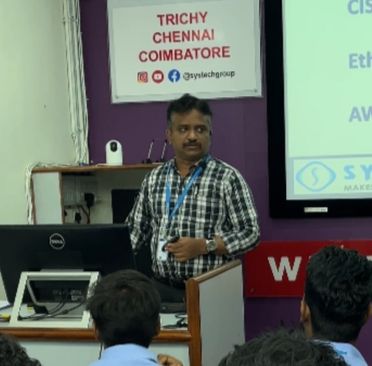
Written by
Leo Antony Raj
Senior Trainer · Networking, Cyber Security and Cloud
Leo Antony Raj has over 20 years of hands-on experience in hardware, networking, server configuration, ethical hacking and cloud computing. He has trained more than 10,000 students, and he teaches networking first, because every security and cloud role is built on it.