
By Leo Antony Raj, Senior Trainer, Systech Group 20+ years in networking and cybersecurity · Updated November 2026.
6 Min read
In short
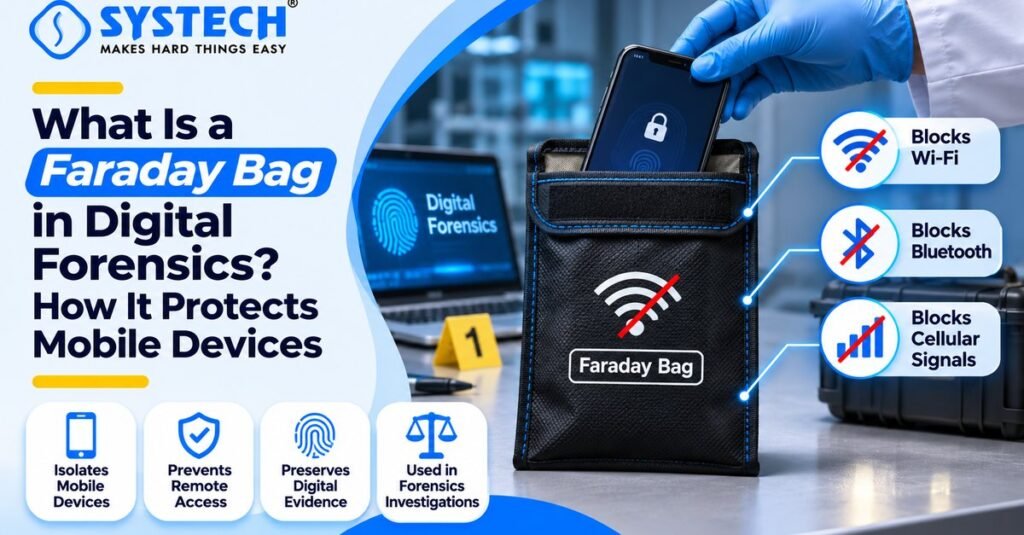
A Faraday bag is an RF-shielding enclosure designed to reduce or block wireless signals entering and leaving a device.
It can help isolate seized phones from cellular, Wi-Fi, Bluetooth and other radio-frequency communication, depending on its design and tested performance.
In digital forensics, isolation helps reduce the risk of remote wiping, remote commands and network-based changes to evidence.
A bag must be properly sealed and tested; poor closure, damage or unsuitable frequency coverage can allow signals through.
Signal isolation can increase battery drain because a phone may keep searching for a network.
Airplane mode is not automatically equivalent to RF isolation. Investigators must verify the device’s actual connectivity state.
A Faraday bag supports evidence preservation but does not replace forensic acquisition, documentation or chain-of-custody procedures.
Table of Contents
A seized smartphone can continue communicating with cellular networks, Wi-Fi access points and other wireless devices even after it has been collected as evidence. Incoming communication may change the device’s data or create a risk of remote wiping. Investigators therefore need a reliable way to isolate the device from external wireless networks while preserving its condition for examination.
A Faraday bag is a specially designed RF-shielding pouch that helps block electromagnetic signals from reaching or leaving an electronic device. When the bag is properly designed, sealed and tested, it can isolate a mobile phone from supported wireless connections. This makes it a useful tool in digital forensics, incident response and evidence handling.
However, placing a phone inside a Faraday bag is not a complete forensic procedure by itself. Investigators must consider the phone’s power state, battery condition, volatile data, shielding effectiveness and chain of custody. This guide explains how Faraday bags work, what signals they may block, how to use them responsibly and where their limitations matter.
What Is a Faraday Bag in Digital Forensics?
A Faraday bag is a pouch or enclosure made with conductive shielding materials. Its construction is intended to reduce electromagnetic signals passing between the inside and outside of the enclosure. Understanding how mobile devices communicate and how security threats affect them is useful for learners pursuing practical cyber security training in Trichy with hands-on security labs
The concept is based on a Faraday cage, named after scientist Michael Faraday. A Faraday cage uses a conductive enclosure to shield its interior from external electromagnetic fields. A Faraday bag applies this principle in a portable form so investigators can isolate phones and other wireless-enabled devices during collection and transport.
What makes a forensic Faraday bag different from an ordinary pouch?
A normal pouch mainly provides physical storage or protection from scratches and impacts. A Faraday bag is specifically designed for RF shielding. It uses conductive layers and a closure system intended to maintain the shielding around the device. The actual level of protection depends on the product’s construction, frequency range, condition and sealing method.
Does every Faraday bag block every signal?
No. Products differ in their shielding performance and supported frequency ranges. A bag that reduces one frequency band may perform differently at another. The label ‘Faraday bag’ alone is not proof that a particular device will be fully isolated. Investigators should use equipment suitable for the required frequencies and regularly test it under their organisation’s procedures.
Why Do Investigators Isolate Mobile Devices?
A mobile phone is not a passive storage device. When powered on, it may exchange information with cellular networks, Wi-Fi networks, Bluetooth accessories and other services. That communication can affect the device after it has been seized.
Prevent remote wiping or alteration
Some devices and services support remote erase, lock or management commands. If a seized phone remains connected, a remote action may change or delete information before forensic acquisition. Network isolation helps reduce this risk by preventing communication with external networks. Learning about attack methods and device vulnerabilities is part of ethical hacking training in Trichy with practical cybersecurity exercises
Reduce remote access and incoming changes
Isolation can prevent new messages, application data, synchronisation events and other network-delivered information from reaching the device. This helps preserve the device’s state for examination. It does not prevent changes caused locally by the device itself or by someone with physical access.
Support evidence preservation
A documented isolation process helps investigators explain how they protected the device after collection. The bag is one part of evidence preservation; photographs, device-state notes, timestamps, evidence labels, secure storage and chain-of-custody records are also important.
Limit location and network communication
When effective, RF shielding can prevent a device from exchanging signals with cellular towers, Wi-Fi access points and other radio systems. This may reduce network-based tracking or communication while the device remains sealed. The result depends on the shielding performance and whether the closure remains intact.
How Does a Faraday Bag Work?
A Faraday bag uses conductive shielding layers to form an enclosure around the device. These layers interact with electromagnetic fields and reduce the amount of radio-frequency energy that passes through the enclosure. When the device is fully enclosed and the bag is correctly sealed, wireless signals may be attenuated enough to prevent normal communication.
Step-by-step working principle
A mobile phone normally receives and transmits radio signals through its antennas.
The phone is placed inside the RF-shielding bag.
The conductive shielding material reduces the signals that can enter or leave the enclosure.
The closure is sealed according to the manufacturer’s instructions so that gaps do not compromise the shielding.
If the bag’s shielding is effective across the relevant frequency bands, the phone loses its external wireless connections.
The device remains isolated while it is transported or held for the next authorised forensic step.
The diagram on page 4 of your supplied research brief illustrates this basic concept: radio waves approach a conductive Faraday cage, while the enclosure reduces their passage into the protected space.
Why is the seal important?
A gap or poorly closed seam can weaken the enclosure’s shielding. The same applies to worn conductive fabric, damaged seams, contamination or repeated use beyond the product’s service life. Follow the manufacturer’s sealing instructions and test the complete enclosure, not only the shielding material.
Which Signals Can a Faraday Bag Block?
A suitable and properly sealed RF-shielding bag may block or reduce several wireless signal types. The exact result depends on the bag’s tested frequency range and shielding effectiveness. Understanding cellular, Wi-Fi and other network communication technologies is useful when learning through CCNA networking training in Trichy with practical network configuration.
A Faraday bag does not make the device physically inaccessible, and it does not erase data already stored on the phone. It is intended to reduce wireless communication while the device is enclosed.
Where Are Faraday Bags Used in Digital Forensics?
Mobile device forensics
Investigators may use RF-shielding bags when collecting smartphones and tablets so that network communication is restricted while the device is transported to a controlled examination environment.
Cybercrime and criminal investigations
A seized phone may contain call records, messages, photographs, application data, account information and other potential evidence. Isolation helps reduce the chance that remote communication will alter the device before examination. These investigation and threat-monitoring concepts are relevant to SOC analyst training in Trichy covering security monitoring and incident response.
Corporate investigations
Organisations may need to preserve company-owned mobile devices during internal investigations, incident response or suspected data misuse. The collection and isolation process should follow company policy, applicable law and the investigation’s authorised scope.
Incident response
During a security incident, a mobile device may be relevant to an investigation involving account compromise, suspicious applications or unauthorised access. RF isolation can help prevent further network interaction while trained responders determine the next steps. Learners interested in identifying and investigating security weaknesses can explore penetration testing training in Trichy with vulnerability assessment and security testing.
Privacy-sensitive handling
RF-shielding products may also be used in settings where wireless communication needs to be restricted for privacy or operational reasons. Their use should be lawful and appropriate to the environment.
Faraday Bag vs Normal Bag vs Airplane Mode
Airplane mode should not be treated as a guaranteed substitute for RF shielding. The SWGDE mobile-device guidance notes that newer operating systems may not disable every wireless protocol in airplane mode, or may only disconnect them temporarily. Investigators should verify connectivity or use an appropriate RF-shielded enclosure when required.
How to Use a Faraday Bag During Evidence Collection
The exact procedure must follow the investigator’s training, agency policy, legal authority and the device’s condition. The following is a general educational workflow, not a replacement for an organisation’s approved seizure procedure.
Step 1: Identify and document the device
Record the device make, model and visible identifying details where possible. Photograph its condition, screen state, visible damage, connected accessories and the location where it was found. Do not casually explore applications or change settings.
Step 2: Assess the device state
Determine whether the device is powered on, powered off, locked, unlocked, damaged or connected to accessories. The decision to change its state can affect evidence and future access. If the device is powered off, do not turn it on simply to check it.
Step 3: Follow the approved isolation decision
Use the organisation’s mobile-device procedure to decide whether to use an RF-shielding enclosure or another approved isolation method. Airplane mode may not disable all wireless services. If it is used, verify the relevant radios and connectivity rather than assuming the setting is sufficient.
Step 4: Place the device inside a tested bag
Use an RF-shielding bag appropriate for the device size and required frequency range. Place the device inside without damaging it or compromising other physical evidence. Seal it exactly as directed by the manufacturer.
Step 5: Label and record the evidence
Attach or complete the evidence label with the unique evidence identifier and required case details. Record the date, time, collector and any relevant handling action. Document the bag or enclosure used and its condition.
Step 6: Maintain isolation during transfer
Keep the device within the RF-shielded environment during transport when isolation is required. Avoid opening the bag in an uncontrolled area. If transferring between shielded spaces, follow procedures that prevent momentary exposure to external networks.
Step 7: Transfer for forensic examination
Move the device to the appropriate forensic environment as soon as practical. The examiner should document the condition on receipt and follow the approved acquisition process. A Faraday bag does not itself acquire or analyse the device’s data.
Not sure which route fits you?
Tell us your stream and what you are hoping for, and we will tell you honestly which option suits.
Get course detailsDevice Power, Battery and Volatile-Data Precautions
A key point in mobile device isolation is that network protection and device-state preservation must be considered together. A powered-on phone may continue operating inside a Faraday bag. Because it cannot find a network, it may repeatedly search for a signal and consume additional battery power.
Can a Faraday bag drain a phone battery?
It can contribute to faster battery depletion. A device that repeatedly searches for unavailable cellular or wireless networks may use more power. If the battery runs out, the device may shut down or change state. This can affect access to evidence, particularly where the device was unlocked or where volatile information may be relevant.
Should investigators switch a seized phone off?
There is no universal instruction to always power a seized phone off or always leave it on. Powering down can affect access, encryption state and authentication requirements; leaving it on can create battery and network risks. The correct decision depends on the device, case circumstances, available tools and agency procedure. Investigators should consult trained mobile-device examiners and document the decision.
Can a phone be charged inside a Faraday bag?
Some specialised RF-shielding enclosures provide filtered power or charging connections. These are designed to maintain power without creating an unshielded path through the enclosure. A normal cable routed from a phone inside the bag to an external power source may compromise shielding and potentially act as an antenna. Do not improvise a charging arrangement.
Why does volatile data matter?
Volatile information may be lost when a device powers down or changes state. The value and availability of this information depend on the device and operating system. A trained examiner should decide how to preserve the device state and move to acquisition promptly. Do not assume that placing a phone in a bag automatically preserves all volatile data.
Limitations and How to Test Shielding Effectiveness
Faraday bags are useful tools, but they have limitations. Their performance is not guaranteed simply because the product is labelled as RF shielding.
How should a Faraday bag be tested?
Follow the manufacturer’s recommended inspection and testing method.
Test the complete enclosure, including the closure and seams, rather than only a sample of the shielding material.
Use a suitable test method or equipment that covers the wireless frequencies relevant to the devices being isolated. Record the date, test method, result, product identifier and any damage or repair.
Knowledge of network devices, wireless connectivity and technical troubleshooting can be developed through hardware and networking training in Trichy with practical lab sessions.
Common Mistakes During Mobile Device Isolation
Frequently asked questions
What is a Faraday bag used for in digital forensics?
A Faraday bag is used to isolate mobile devices from external wireless communication. It can help reduce the risk of remote wiping, remote commands and network-based changes while a seized device is being handled or transported.
How does a Faraday bag protect a mobile phone?
It uses conductive shielding materials to reduce electromagnetic signals entering or leaving the enclosure. When the device is fully enclosed and the bag is properly sealed, supported wireless connections may be blocked.
Can a Faraday bag block 5G, Wi-Fi and Bluetooth?
A suitable bag may block or attenuate cellular signals, Wi-Fi and Bluetooth, but performance depends on its tested frequency range, construction and closure. Check product specifications and test the complete enclosure.
Does a Faraday bag block GPS?
It may prevent a device from receiving GPS or other satellite-navigation signals if the relevant frequencies are sufficiently attenuated. Actual performance depends on the shielding design and condition.
Can a Faraday bag prevent remote wiping?
It can help prevent remote wipe commands from reaching a device while effective RF isolation is maintained. It cannot undo a wipe that has already occurred or prevent every form of local data change.
Is airplane mode the same as using a Faraday bag?
No. Airplane mode is a device setting and may not disable every wireless protocol. A Faraday bag provides external RF shielding, but it too must be properly sealed and tested.
Can a phone remain switched on inside a Faraday bag?
Yes, a phone can remain powered on inside the bag, but it may continue searching for a network and drain its battery faster. Whether it should remain on depends on the forensic circumstances and approved procedure.
Can I charge a phone while it is inside a Faraday bag?
Only use a purpose-designed enclosure and approved filtered power connection that maintains RF shielding. An ordinary cable routed outside the bag may compromise isolation.
Does a Faraday bag preserve all digital evidence?
No. It helps reduce network-based changes but does not prevent physical access, all local changes, hardware failure or battery depletion. Proper forensic acquisition, documentation and chain of custody are still required.
How often should a forensic Faraday bag be tested?
Follow the manufacturer’s guidance and the organisation’s evidence-handling policy. Test the complete enclosure regularly and after damage or suspected failure, and document the method and results.
Final Thoughts
A Faraday bag is an important mobile-device isolation tool in digital forensics. By reducing wireless signals entering or leaving a properly sealed enclosure, it can help protect a seized device from remote communication and network-based interference before examination.
Its effectiveness depends on the bag’s shielding performance, supported frequency range, physical condition and closure. Investigators must also consider battery drain, volatile data, device power state and the possibility that a device may continue operating while isolated.
The safest approach is to use a tested RF-shielding enclosure as part of a documented forensic process. Identify and photograph the device, follow approved isolation procedures, label the evidence, maintain chain of custody and transfer it promptly for examination.
Written by
Leo Antony Raj
Senior Trainer · Networking, Cyber Security and Cloud
Leo Antony Raj has over 20 years of hands-on experience in hardware, networking, server configuration, ethical hacking and cloud computing. He has trained more than 10,000 students, and he teaches networking first, because every security and cloud role is built on it.